

What InnovoCommerce Refers To—and How It Relates to InnovoClinical
The short answer: identify the label, not the relationship
InnovoCommerce refers, in its own published descriptions, to a clinical-trial technology offering for sponsors and contract research organizations. Its product materials describe tools and dashboards for clinical-study management across operations from startup to closeout, while a DIA marketplace listing describes clinical AI that connects documents, data, and evidence across protocol development, study startup, site engagement, and risk-based monitoring.
InnovoClinical documents a separate set of offerings under its own name. Our Innovo Copilot is clinical-trial AI software for sponsors and CROs, and it drafts protocol sections with evidence-backed language. The published descriptions support keeping the two labels separate during your evaluation; they do not establish that InnovoCommerce is owned by, operated by, or included in InnovoClinical’s portfolio.
Your practical decision rule is straightforward: treat InnovoCommerce as the name of the offering described on InnovoCommerce materials, treat InnovoClinical’s protocol-authoring capability as the offering described on InnovoClinical materials, and keep the relationship between the two unresolved until you receive a direct clarification. That approach lets you investigate the technology without turning a similar name into an unsupported corporate or product connection.
What InnovoCommerce describes itself as providing
InnovoCommerce describes its platform as supporting clinical-study operations from startup to closeout. Its product page stated that InnovoCommerce had supplied clinical-study software on an enterprise scale for more than 10 years. These statements describe InnovoCommerce’s own offering and experience; they do not establish facts about InnovoClinical.
InnovoCommerce describes its offering as a suite of tools and dashboards intended to streamline and manage clinical studies. This language gives you a useful category-level understanding: the name is associated with clinical-study software and operational management rather than with a narrow protocol-writing feature alone. The description does not, by itself, specify which modules your organization would receive, how a deployment would be configured, or which workflows would be in scope.
InnovoCommerce presents its technology to sponsors and CROs working across clinical development and study operations. Its materials connect the offering with clinical-study management, protocol development, study startup, site engagement, and risk-based monitoring. You can therefore place the name within the clinical-trial technology category, but you should not infer a particular implementation, integration, service level, or outcome from that category description.
InnovoCommerce identifies a clinical-trial technology offering; the label does not establish who owns it, whether another organization resells it, or whether its capabilities match those documented by InnovoClinical. Record the name, website, stated capabilities, and commercial contact under InnovoCommerce until the relationship question has been answered directly.
The broader InnovoCommerce technology description
InnovoCommerce describes its clinical AI as connecting documents, data, and evidence in a personalized knowledge base. The same description says that agentic AI is applied across clinical research and development, protocol development, study startup, site engagement, and risk-based monitoring. These statements explain how InnovoCommerce positions its technology across the study lifecycle, while remaining claims made by InnovoCommerce about its own offering.
InnovoCommerce also describes a clinical operations copilot for global clinical trials. The description says that the copilot integrates with eClinical systems and provides completed workflows plus on-demand answers about training and documents. That wording can help you understand the intended operational context, but it does not prove that every listed capability is available in every configuration or that the same copilot is part of InnovoClinical’s product set.
The combined InnovoCommerce descriptions point to a broad clinical-operations technology position rather than a single-purpose protocol-authoring product. They mention study management, connected information, AI-supported workflows, and clinical systems. They do not establish a corporate relationship with InnovoClinical, a shared product roadmap, shared contracts, shared data ownership, or equivalent functionality between the two offerings.
The published descriptions can guide your clarification questions, but they cannot complete the relationship question. If your evaluation concerns protocol authoring, ask which named organization provides that capability, which product name appears in the proposal or technical materials, and which organization would be responsible for implementation and support. Those questions keep technology scope separate from brand resemblance.
What the InnovoCommerce materials do—and do not—establish
The InnovoCommerce materials establish how InnovoCommerce presents itself: as a clinical-trial technology offering with tools, dashboards, clinical AI, and operational coverage extending from study startup through closeout. The materials also associate the offering with protocol development, site engagement, risk-based monitoring, connected information, and clinical-study management.
The InnovoCommerce descriptions do not establish that InnovoCommerce is an InnovoClinical product, subsidiary, division, implementation partner, or alternate name. InnovoClinical’s own materials identify Innovo Copilot as our clinical-trial AI software and describe our protocol-authoring capability separately. Similar wording about clinical AI does not resolve the organizational relationship.
Several assumptions should remain outside your working conclusion. You should not assume that the two names identify the same company, that a feature described by InnovoCommerce is available through InnovoClinical, that InnovoClinical resells InnovoCommerce, or that a reference to one name satisfies a requirement written for the other. You should also avoid carrying over pricing, implementation terms, integrations, credentials, or performance expectations from one name to the other.
A useful evaluation record can contain two separate entries: one for InnovoCommerce and one for InnovoClinical. Record the exact organization name, website, product name, stated capability, and responsible contact under the appropriate entry. Add the relationship as an open question rather than as a completed field.
InnovoClinical’s documented protocol-authoring offering
We offer AI-powered protocol authoring to simplify drafting and optimizing study protocols using real-world data, with compliance and scientific integrity in view. Our Clinical Operations Copilot assists sponsors and CROs in optimizing study design and protocol authoring. These statements describe InnovoClinical’s documented offering and should be evaluated separately from the descriptions published under the InnovoCommerce name.
Our Innovo Copilot uses advanced AI technologies to assist with protocol authoring and bulk generation of study-startup packages. The supported point is assistance with those activities; it is not a general assurance about study speed, approval, quality, or operational results. If your requirement includes startup-package generation, keep that requirement tied to the InnovoClinical offering described here.
Our Innovo Copilot drafts protocol sections with evidence-backed language and AI quality-control agents. This description identifies a protocol-drafting function and a quality-control approach within our documented offering. It does not establish that InnovoCommerce provides the same function, uses the same product, or has any relationship with us.
Our materials describe Innovo Copilot as clinical AI and clinical-trial AI software for sponsors and CROs. The wording differs slightly between the two pages, but both descriptions identify the same named InnovoClinical product and audience. For your evaluation, the relevant distinction is the named provider and offering: Innovo Copilot is documented by us, whereas the InnovoCommerce descriptions are published under the InnovoCommerce name.
Protocol authoring is therefore a useful comparison point, not proof of a relationship. Our documented service covers assistance with study design and protocol authoring, including drafted protocol sections with evidence-backed language and AI quality-control agents. InnovoCommerce materials also mention protocol development, but a shared topic does not demonstrate shared ownership, shared software, or interchangeable delivery. Ask which named organization stands behind the capability in any specific evaluation.
Keep the names separate during technology evaluation
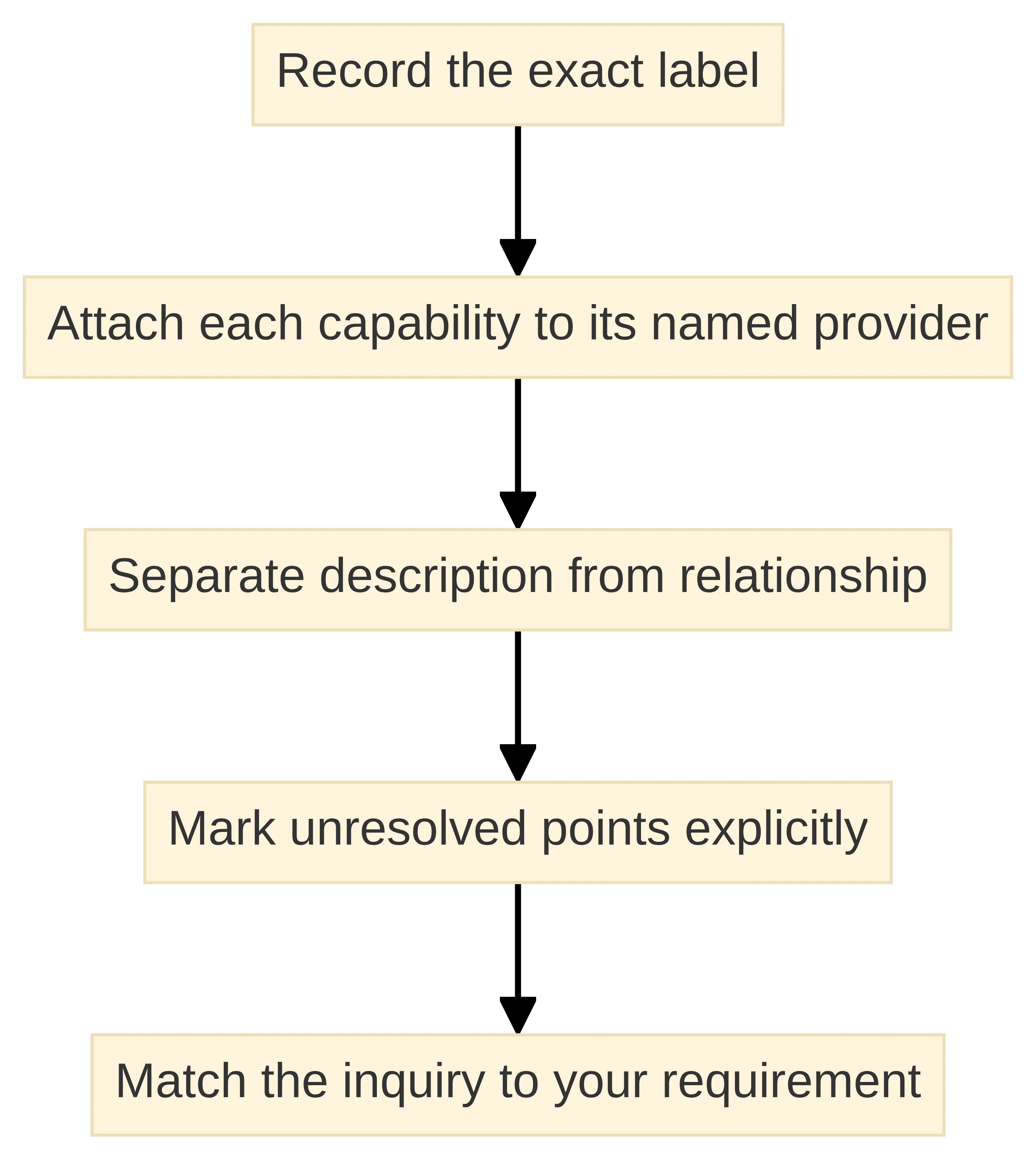
A name-separation method helps you compare clinical-trial technology without assigning capabilities to the wrong organization. Use the following sequence whenever a product name, domain, or proposal introduces both InnovoCommerce and InnovoClinical.
Five separate checks keep the comparison focused:
- Record the exact label. Write down whether the material names InnovoCommerce, InnovoClinical, Innovo Copilot, or another product. Do not shorten different names into a single entry.
- Attach each capability to its named provider. Place clinical-study management, clinical AI, protocol development, or protocol authoring under the organization that actually describes it.
- Separate description from relationship. A page can describe a capability without establishing ownership, partnership, resale, or integration with another organization.
- Mark unresolved points explicitly. Use a question such as “What is the relationship between these organizations?” rather than filling the field with an assumption.
- Match the inquiry to your requirement. If your need is protocol authoring, ask about protocol drafting, study-design assistance, evidence-backed language, and quality-control support. If your need is broader study operations, ask separately about the operational capabilities attributed to InnovoCommerce.
This method preserves the distinction between a broad clinical-operations description and InnovoClinical’s documented protocol-authoring offering. Your comparison can then address the actual requirement, responsible organization, named product, and unresolved relationship without treating similar terminology as proof of equivalence.
The method does not determine which platform is suitable for your organization. Your clinical, operational, regulatory, information-security, and procurement teams must apply their own requirements to the organization and product that ultimately answer your inquiry.
What remains unresolved
The corporate relationship between InnovoCommerce and InnovoClinical remains unresolved. The supplied descriptions identify two names and describe related areas of clinical-trial technology, but they do not give you a supported basis for calling the organizations the same, affiliated, partnered, or unrelated.
The product relationship also remains unresolved. InnovoCommerce describes clinical AI, protocol development, study startup, site engagement, risk-based monitoring, and clinical operations; we describe Innovo Copilot and our protocol-authoring service. Those overlapping subject areas do not show whether a product is shared, integrated, licensed, resold, or independently developed.
Commercial responsibility remains an open question as well. You do not yet have a supported basis for assigning contracting, implementation, support, data handling, pricing, or delivery responsibility from one name to the other. Keep those issues separate from the identity question and ask for a direct answer before relying on either name in a procurement record.
The repeated “Innovo” prefix is not enough to resolve any of these points. Treat the shared word as a reason to ask a focused question, not as evidence of a shared organization or product. The boundary is simple: do not represent InnovoCommerce as part of InnovoClinical’s portfolio until the relationship has been clarified.
How to verify the relationship before proceeding
A focused clarification should answer the relationship question and the capability question separately. Ask for direct answers to these points:
- Is InnovoCommerce affiliated with InnovoClinical, or are they separate organizations?
- Is any InnovoCommerce product offered, licensed, integrated, or supported through InnovoClinical?
- Which organization would provide protocol authoring and study-design assistance?
- Which named product should appear in a technology evaluation focused on protocol drafting?
- Which organization would be responsible for the commercial relationship, implementation, support, and applicable data-handling terms?
You can make the inquiry more precise by describing your actual requirement: protocol authoring for sponsor or CRO teams, study-design assistance, drafted protocol sections with evidence-backed language, or AI quality-control support. Our documented materials associate those capabilities with InnovoClinical and Innovo Copilot. A direct response can then distinguish those capabilities from the broader InnovoCommerce descriptions.
Keep the response with your evaluation record and preserve the exact organization and product names used in the reply. If the relationship is confirmed, update the record with the stated connection and scope. If the relationship remains unclear, continue treating the names as separate and do not use one organization’s description to fill a requirement assigned to the other.
The practical conclusion is narrow but useful: InnovoCommerce is described as a clinical-trial technology offering, while InnovoClinical documents its own Innovo Copilot and protocol-authoring capabilities. A direct clarification is the appropriate basis for connecting those names; until then, keep the offerings distinct in your research and procurement decisions.
Questions to resolve before treating InnovoCommerce as part of a product portfolio
What does InnovoCommerce refer to in clinical trial technology?
InnovoCommerce refers to a clinical-trial technology offering for sponsors and contract research organizations, providing tools and dashboards for managing clinical-study operations from startup to closeout.
How does InnovoCommerce differentiate from InnovoClinical's offerings?
InnovoCommerce describes its own platform and capabilities separately from InnovoClinical, which has its own documented offerings like Innovo Copilot for protocol authoring and study design assistance.
What should I do if I need clarification on the relationship between InnovoCommerce and InnovoClinical?
You can request clarification from InnovoClinical to understand whether InnovoCommerce is affiliated with them or if they are separate organizations.
What capabilities does InnovoCommerce claim to provide?
InnovoCommerce claims to provide a suite of tools and dashboards for clinical-study management, including support for protocol development, study startup, site engagement, and risk-based monitoring.
What is the role of the Clinical Operations Copilot mentioned by InnovoCommerce?
The Clinical Operations Copilot is described as integrating with eClinical systems to provide completed workflows and on-demand answers about training and documents for clinical trials.
How can I evaluate the technology offerings of InnovoCommerce and InnovoClinical?
When evaluating, keep the names separate, record the exact capabilities attributed to each, and clarify any unresolved relationship questions before making decisions.