

AI in Clinical Trials: An Executive Framework for Evaluating Use Cases
Start with the consequence of the AI output
An executive evaluation of AI in clinical trials should begin with the consequence of the output, not with the sophistication of the tool. An output that helps organize documents has a different control burden from an output that influences eligibility, endpoint assessment, participant care, or a decision about whether a study proceeds. The first question is therefore: what decision or workflow will change because this output exists?
The consequence of an AI output determines the evidence and accountability you need around it. Use this sequence before comparing platforms:
- Name the output. Define whether the system produces a draft, summary, prediction, recommendation, classification, alert, or analysis.
- Name the recipient. Identify the role that receives the output and the record or workflow in which it appears.
- Name the decision. State what the recipient may do differently because of the output.
- Name the consequence. Describe what could happen to participants, study validity, timelines, compliance, or operational resources if the output is wrong or misunderstood.
- Name the control. Specify the review, approval, monitoring, change control, or escalation that must remain in place.
This sequence turns a broad technology discussion into a bounded operating question.
A proportionate evaluation does not mean a low-consequence workflow receives no scrutiny. It means the scrutiny is connected to the role the system performs and the harm an error could create. ICH E6(R3) calls for Good Clinical Practice to be tailored to the trial design and technologies used, with proportionate risk management that protects participants and preserves reliable results. Use that principle to set the evaluation boundary before you ask whether AI belongs in the workflow.
Separate workflow assistance from consequential trial decisions
AI-for-trial-operations supports trial design, conduct, or analysis without being the treatment under study, while AI-as-intervention is part of the clinical intervention being evaluated. That distinction changes the question you must answer. An operational assistant may be assessed through workflow accuracy, decision impact, transportability, and safety under real-world conditions. An AI intervention generally requires prospective clinical evaluation, prespecified estimands, governed model behavior, and protocol-level oversight.
The role of the system provides the first decision branch for your evaluation:
| Evaluation branch | What the system does | Evidence and control emphasis | Executive boundary |
|---|---|---|---|
| AI-for-trial-operations | Supports study design, conduct, or analysis without being the treatment under study | Workflow accuracy, decision impact, transportability, real-world safety, and explicit change control where the use affects endpoints or inference | Treat the output as bounded support for a defined workflow; do not assume operational use removes the need for oversight |
| AI-as-intervention | Forms part of the clinical intervention being evaluated | Prospective clinical evaluation, prespecified estimands, governed model behavior, and protocol-level oversight | Treat the system as part of the intervention and plan the evaluation accordingly |
Classify the intended use before you compare features, interfaces, or demonstrations. If the system affects an endpoint, an inferential model, or a decision with direct consequences for trial conduct, document the additional change-control and oversight questions rather than placing it in the same category as document assistance.
Map the clinical-development use cases before comparing tools
A clinical-development use-case map should connect each AI application to the work it may influence and the decision that follows. The map can include:
- Study design and protocol work: testing design assumptions, organizing protocol content, and examining how inclusion and exclusion criteria affect feasibility.
- Feasibility, site selection, and recruitment: assessing recruitment likelihood from protocol complexity and site characteristics, then identifying where a proposed design may create dropout risk.
- Operational workflows: helping people find information, prepare recurring materials, or coordinate study tasks without transferring accountability to the system.
These are investigation categories, not a conclusion that every AI product performs every task. Use the map to distinguish three questions that are often collapsed: whether a tool can produce an output, whether the output is fit for the intended decision, and whether the organization can operate it with the required review and records. This prevents a capability demonstration from standing in for evidence about a particular workflow. It also makes tool comparisons more disciplined: compare systems against the same output, decision owner, source data, and control boundary rather than against feature lists alone.
Each use case needs a short decision record. State the source data, intended output, user, decision, review point, and failure consequence. Then specify whether the initial assessment concerns workflow accuracy, the effect on a decision, performance in another setting, or safety under real-world conditions. The same tool may require different controls when it moves from drafting a document to informing an endpoint or inferential analysis.
Those functions bring different questions about feasibility, data, interpretation, records, and accountability. Select one use case only after each affected function can describe the decision boundary in ordinary operational terms.
Begin where AI can test design assumptions
Study design is a practical starting point when the organization has a specific assumption it wants to examine before execution. AI systems can use historical datasets and real-world data to simulate protocols and assess feasibility. Predictive models can assess recruitment likelihood from protocol complexity and site characteristics and identify risks such as high dropout rates. Prior trial data can also be analyzed to identify inclusion and exclusion criteria that balance specificity with recruitment feasibility.
A design-assumption assessment should follow a defined sequence:
- State the assumption, such as whether a proposed eligibility rule is workable across the intended study population and sites.
- Identify the historical or real-world data that could bear on that assumption and record its relevant limitations.
- Define the output as an estimate, scenario, comparison, or flagged risk rather than as an automatic design decision.
- Set the human review point where clinical, statistical, and operational experts decide whether the output changes the protocol discussion.
- Record what will count as useful information and what would make the result unsuitable for the intended decision.
A feasibility signal does not establish that a protocol is scientifically appropriate, ethically acceptable, or ready for deployment. Use the output to test an assumption, then keep protocol judgment with the accountable study team. ICH E6(R3) requires the application of Good Clinical Practice to fit the trial design and technologies used, so the design context remains part of the assessment. That boundary also matters when outputs appear plausible. A plausible feasibility estimate can identify an issue worth examining, but it does not explain whether the underlying data represent the intended population or whether a proposed change remains acceptable across the study context. Keep those questions visible in the review record so that a design discussion does not silently become an automated protocol decision.
Treat potential benefits as hypotheses, not outcomes
Potential benefits of AI in clinical trials should be written as hypotheses tied to a measurable decision or workflow. A proposed use might test whether protocol review becomes more consistent, whether feasibility analysis identifies a recruitment concern earlier, or whether study staff can locate an approved document with fewer handoffs. None of those statements establishes an achieved result. The evaluation must define what will be measured, against what comparison, and under which operating conditions.
AI implementation also carries practical limitations. Reported limitations include substantial technology and infrastructure investment, specialized expertise in clinical research and machine learning, privacy and informed-consent concerns, and limited empirical validation of effectiveness in planned clinical trials. Treat each limitation as an evaluation condition: identify the people, data, infrastructure, controls, and validation work required before you interpret a promising demonstration as a usable workflow. These conditions affect sequencing. An organization may need to resolve data access and handling questions before testing performance, establish who can interpret results before exposing them to a study team, and define validation evidence before treating a workflow as ready for broader use. The practical comparison is not between AI and no AI in the abstract; it is between a bounded AI-assisted process and the existing process, with the decision risk and review burden made explicit.
Match evidence to the decision the system can affect
The evidence required for an AI use case should match the decision the system can affect. For AI-for-trial-operations, assess workflow accuracy, decision impact, transportability, and safety under real-world constraints. Endpoint-support and inferential-modeling uses may also need explicit change control and oversight. A technically accurate output can still be unsuitable if it does not travel to the intended population, cannot be interpreted in the operating context, or changes a decision without an accountable review.
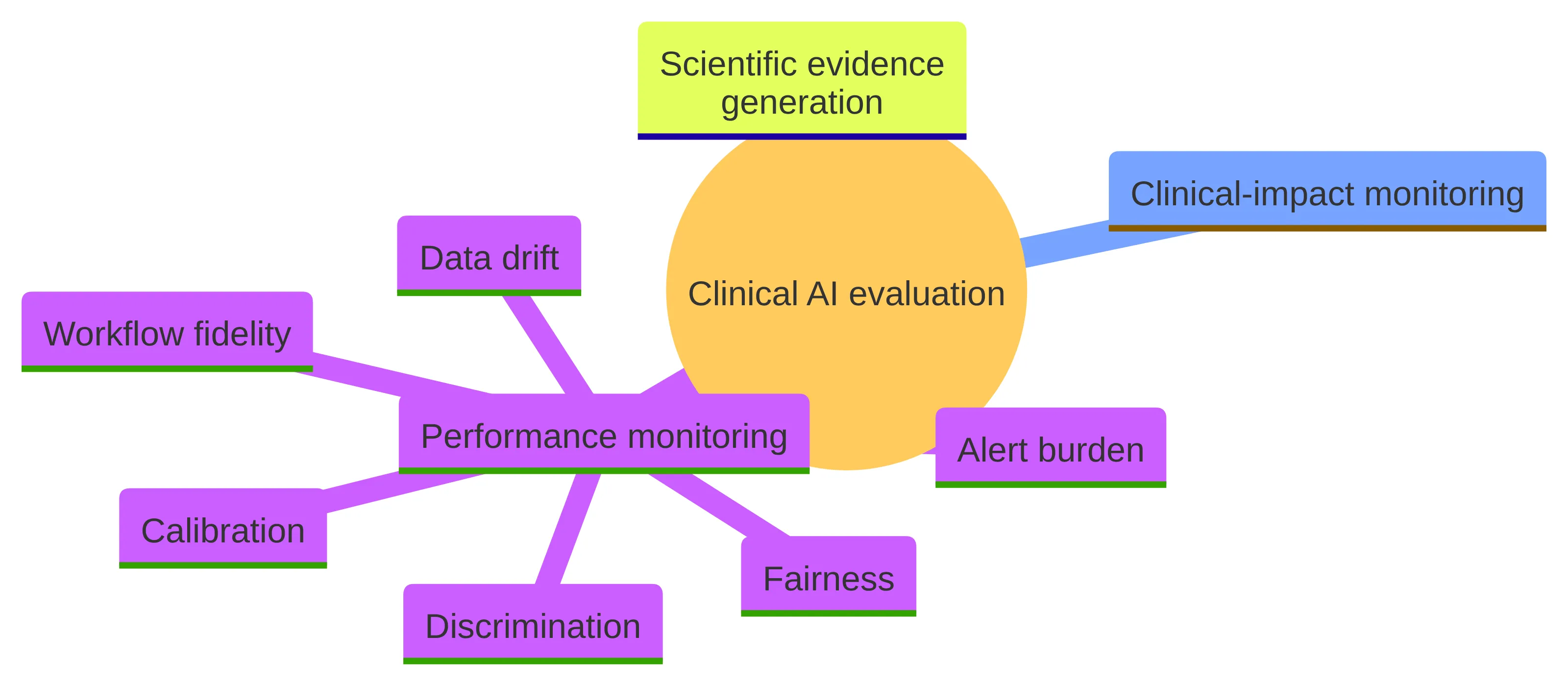
A clinical AI evaluation can be separated into three distinct activities:
- Performance monitoring: examine technical characteristics such as calibration, discrimination, data drift, alert burden, fairness, and workflow fidelity.
- Clinical-impact monitoring: track whether the expected clinical benefit appears to remain over time in the setting where the system is used.
- Scientific evidence generation: produce evidence about the causal effect of deployment on patient outcomes when that question is part of the intended use.
Keep these activities separate in the evaluation plan. A performance result does not by itself answer the clinical-impact question, and a workflow result does not by itself establish a causal effect on outcomes.
Write an evidence brief for the selected use case before accepting a performance claim. The brief should state the intended decision, the relevant population and setting, the measures that matter, the conditions under which the result may change, and the person accountable for interpreting it. Escalate the plan when the output affects endpoints, inference, participant-facing decisions, or other high-consequence trial activities.
Build human accountability into the operating model
Human accountability means assigning a named role to interpret the output, approve the action, and respond when the output is uncertain or wrong. AI can support trial design, conduct, or analysis, but its presence does not transfer scientific, clinical, operational, or regulatory judgment to the system. For an AI intervention, protocol-level oversight is part of the evaluation expectation; for operational AI, the review boundary should follow the consequence of the assisted decision.
A responsible operating model brings the affected functions into the decision record:
- Clinical operations and trial management define the workflow and operational consequence.
- Data science, biostatistics, and informatics define data, methods, interpretation, and technical evaluation.
- Quality assurance and compliance consider records, audit readiness, and controlled use.
- Regulatory and medical governance assess the implications of the intended use.
- Clinical-development leadership sets the decision boundary and accepts the residual responsibility.
The framework is not complete when a model owner is named. The people who own the study decision must remain connected to the output.
Data quality, privacy, informed consent, validation, security, and governance belong in the operating model rather than in a late technical review. Start by identifying what data the workflow uses, what permissions and handling conditions apply, how the output will be checked, and which record preserves the decision. ICH Good Clinical Practice links trial conduct to participant protection and reliable results; the system controls should support that responsibility rather than obscure it.
Define the control questions before deployment
An executive evaluation should answer control questions before a workflow moves beyond a bounded assessment:
- What exact task does the system perform, and what task remains with a person?
- What source data does the output depend on, and how will you identify gaps, outdated content, or unsuitable data?
- What performance measure matters for this decision, and what result would require further investigation?
- How will you assess performance in the population, sites, or operating setting where the workflow will run?
- What happens when the output is uncertain, unavailable, inconsistent, or challenged by a reviewer?
- Who approves a model or workflow change, and what record captures the change and its rationale?
- How will privacy, informed consent, data handling, access, and security requirements be addressed for the intended use?
- Which quality, compliance, regulatory, and medical-governance roles participate in approval and ongoing oversight?
The control questions should be specific to the workflow rather than copied from a generic technology checklist. A drafting assistant, a recruitment-feasibility model, and an endpoint-support system do not create the same decision path. Record the intended use, evidence, reviewer, change boundary, and escalation route for the selected case. If the organization cannot answer those questions, keep the use case in investigation rather than treating a demonstration as deployment readiness. Executives can also ask for the boundary conditions in plain language: the population and setting represented by the evaluation, the kinds of inputs the system is not intended to interpret, the reviewer’s authority to reject or override an output, and the event that triggers reassessment. These answers show whether governance is operational or only described at a policy level. They also reveal whether the proposed use is narrow enough to evaluate without conflating several decisions.
Use monitoring to test whether the workflow remains dependable
Monitoring should test the workflow after the initial assessment, not only the model before launch. Performance monitoring can examine calibration, discrimination, data drift, alert burden, fairness, and workflow fidelity. Clinical-impact monitoring asks whether the expected benefit remains over time in practice. Scientific evidence generation addresses causal effects on patient outcomes when that question belongs to the intended use. These are different questions and should remain visible as different parts of the operating plan.
A monitoring plan should connect each measure to an action. Decide who reviews a drift signal, what triggers a workflow pause or investigation, how a change is documented, and when the use case must be reassessed in a new setting. For an endpoint or inferential use, include explicit change control and oversight. For a workflow assistant, define the accuracy, decision-impact, transportability, and real-world safety questions that determine whether continued use remains justified. Require that plan before expanding beyond the first bounded workflow. Monitoring results should feed back into the use-case decision, not remain as a separate technical report. A change in data, setting, workflow, or model behavior can alter the relevance of earlier evidence. Record the condition being monitored, the decision it informs, and the owner of the response. That record helps distinguish a temporary operational issue from a reason to narrow, pause, or re-evaluate the use case.
Apply proportionate risk management across jurisdictions
ICH Good Clinical Practice applies across clinical-trial types, designs, and settings, including trials that use different operational approaches, design elements, and data sources. ICH E6(R3) calls for GCP to be tailored to the trial design and technologies used, while proportionate risk management protects participant rights, safety, well-being, and the reliability of trial results. Inadequate trial design or conduct can put participants at risk, produce unreliable results, and be unethical.
A global study should therefore carry a jurisdiction-aware control record for each AI use case. State where the workflow will operate, which trial activities it touches, which local requirements need review, and how differences affect data, oversight, records, or change control. Do not assume that a control accepted in one operating setting answers every requirement in another. Start with the consequence of the output, then apply the proportionate risk approach to the actual study design and technology. Jurisdiction-aware review is not a substitute for technical evaluation. It connects the same use case to the places where data are handled, decisions are made, and records must support oversight. For a global sponsor or CRO, document which assumptions are shared across settings and which must be revisited locally. This keeps a workflow from being treated as universally acceptable merely because its technical behavior appeared consistent in one context.
Position InnovoCommerce within a bounded workflow evaluation
We help sponsors and CROs accelerate study execution through AI-powered clinical workflows, intelligent automation, and enterprise-grade trial-management solutions. That positioning is relevant when your evaluation concerns a defined clinical workflow rather than an abstract question about AI. The appropriate next step is to connect the proposed workflow to its decision, data, reviewer, evidence, and governance requirements.
Our Innovo Copilot assists with protocol authoring, bulk generation of study startup packages, and on-demand answers for study staff about training and documents. Those functions can be examined as separate workflow questions: which content is being prepared or retrieved, who reviews it, what source record governs the answer, and what action follows. Do not treat assistance with preparation or information access as a transfer of study accountability.
Our platform provides cross-functional visibility and progress insights to support faster, informed decisions throughout the clinical-trial lifecycle. Evaluate that role by tracing one decision from the underlying information to the displayed insight, the responsible reviewer, the resulting action, and the record of that action. A bounded trace gives sponsors and CROs a concrete basis for deciding whether the workflow merits deeper evaluation.
Choose one use case for focused investigation
The next decision is whether one defined AI use case deserves focused investigation. Choose a workflow with a clear output, a named decision owner, identifiable source data, a measurable evaluation question, and a proportionate control plan. Classify it as AI-for-trial-operations or AI-as-intervention, then document the evidence, monitoring, governance, human review, and jurisdictional conditions that follow from that classification.
If the use case cannot meet those conditions, narrow the intended use before expanding the technology discussion. Individual regulatory, legal, medical, or clinical suitability decisions require qualified professional judgment for the applicable study and jurisdiction. Use the following follow-up to describe your organization, primary interest, and evaluation context.
What should sponsors and CROs verify before requesting a follow-up?
What limitations should be considered when implementing AI in clinical trials?
Limitations include the need for significant technology investment, specialized expertise, privacy and informed consent concerns, and limited empirical validation of effectiveness.
What is the importance of human oversight in AI clinical trials?
Human oversight is crucial to ensure that scientific, clinical, operational, and regulatory judgments remain with qualified personnel, especially when AI outputs influence critical decisions.
What questions should executives ask when evaluating an AI clinical trial solution?
Executives should inquire about the intended use of the AI, the data sources, the decision-making process, the evidence required for validation, and the governance structure for oversight.
How does InnovoClinical integrate AI into clinical trial management?
InnovoClinical provides AI-powered solutions like Innovo Copilot, which assists with protocol authoring, study startup package generation, and offers on-demand support for study staff.
What is the role of monitoring in AI clinical trials?
Monitoring involves assessing performance, tracking clinical impact over time, and generating scientific evidence to ensure that AI systems continue to meet their intended goals.